
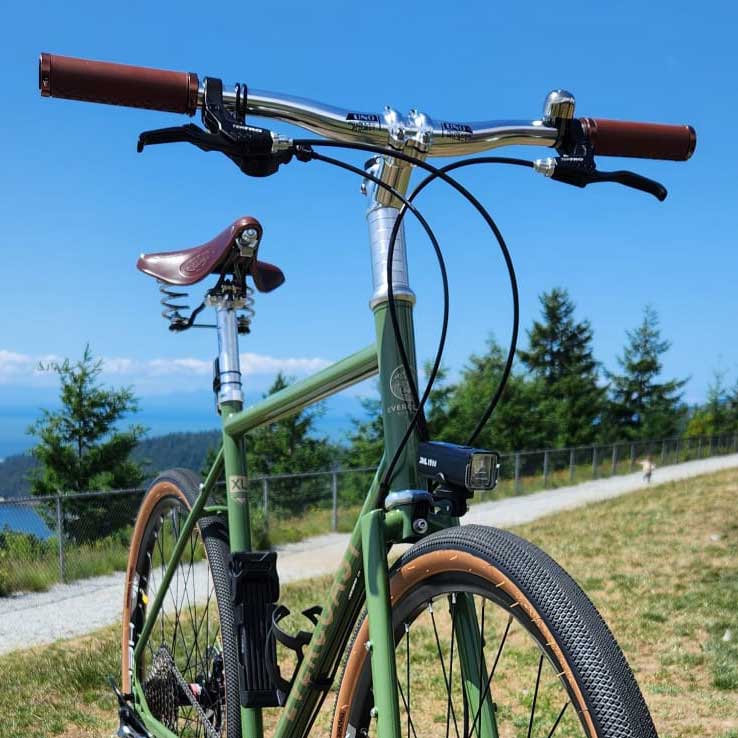
When we started building the Passage, we asked one question before any other: what does a rider in Vancouver actually need from a gravel and all-road bike?
Not what the industry says they need. Not what wins races in Arizona or looks best on a spec sheet. What does a rider need who commutes down the Arbutus Greenway on Tuesday, takes a forestry road off Cypress on Saturday, and wants one bike that handles both without asking them to compromise on either?
The answers to that question are built into every decision we made on the Passage. This is the reasoning behind those decisions.
Why Steel
The Passage is built on a heat-treated, triple-butted 4130 chromoly steel frame. That choice comes before every other decision because the frame material determines everything downstream: ride quality, longevity, serviceability, and what the bike can honestly be asked to do over years of real use.
4130 chromoly is not entry-level steel. It is the same alloy used in aircraft fuselage tubing and motorsport chassis: a chromium-molybdenum alloy with specific mechanical properties that make it the right material for a daily-use bicycle in Vancouver conditions. The compliance is inherent to the material, not manufactured in through a specific carbon layup or tuned out through a too-stiff aluminum section. It absorbs road vibration progressively, which means your hands and lower back feel the difference after two hours on mixed terrain.
Triple butting means the tube walls are engineered at three different thicknesses: thicker at the weld joints where stress concentrates, thinner through the mid-section where the tube needs to flex and carry load. The result is a frame that is lighter than it looks, stiff where it matters, and compliant where you feel it.
Both frames are heat-treated after welding. Welding introduces residual stress into the metal around each joint: post-weld heat treatment relieves that stress and produces a more consistent, longer-lasting frame. Not every production steel frame does this. Ours do.
Two Frames, One Philosophy
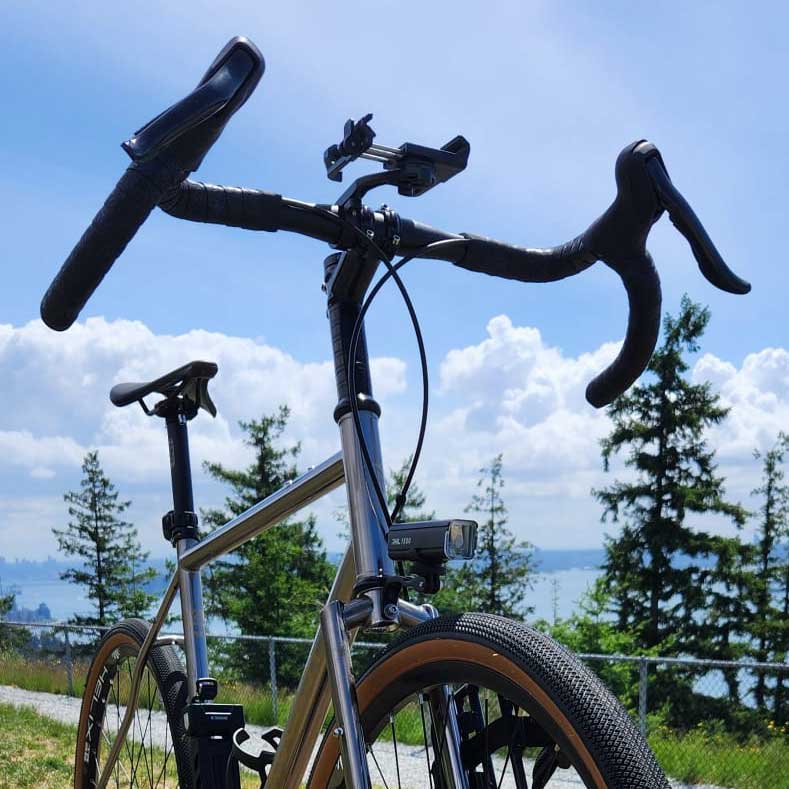
The Passage comes in two versions: the Passage and the Passage Pro. They share the same frame material, the same philosophy, and the same assembly process at our Kitsilano workshop. What they differ on is the specification level and who each one is right for.
The Passage is our most accessible chromoly platform. Quick release axles front and rear, external cable routing, post mount disc brakes, and 40mm tire clearance. These are not budget choices, they are deliberate ones. Quick release means wheel removal is fast and tool-free, which matters for a commuter who pulls a wheel frequently. External cable routing means any adjustment, cable swap, or housing replacement can be done without routing tools or internal guides. Post mount disc brakes are the most widely stocked, most easily serviced brake standard in the world. Any shop, anywhere, has the pads and the knowledge. 40mm tire clearance covers everything from fast urban commuting to loaded touring.
The Passage is the bike for riders who want a reliable, honest steel bike that will be easy to live with and easy to service for years. It is not a compromise. It is the right tool for a specific kind of riding.
The Passage Pro is a more refined platform for riders who want the full modern specification. Thru axles - 12x100mm front, 12x142mm rear - create a measurably stiffer wheel-to-frame interface than quick release. You feel this as improved responsiveness on rougher terrain, better tracking under hard braking, and more confidence when the bike is carrying a load. The difference is not dramatic on smooth pavement but it is real on gravel and particularly noticeable on the North Shore access roads that define weekend riding in this city.
Internal cable routing on the Pro produces a cleaner cockpit and keeps cables protected from the sustained wet-weather exposure that Vancouver delivers for eight months of the year. The wider 45mm tyre clearance opens up proper gravel tyres and gives the bike more range as riding evolves. Flat mount disc brakes are the native standard for modern hydraulic groupsets: Shimano GRX, SRAM Rival, Force, and Wheeltop EDS all run flat mount. If hydraulics are in the plan, the Pro is the cleaner build.
Both frames include the steel fork. The Passage fork runs a QR 100mm front axle. The Passage Pro fork runs 12x100mm thru axle with flat mount disc. Both are the same chromoly steel construction as the frame: consistent material properties throughout, no carbon-steel interface, no dissimilar material bonding to worry about.
The Serviceability Standard
This is the principle we return to more than any other when making component decisions, and it comes directly from a decade of servicing other people's bikes at shops across Vancouver.
The most common conversation in a bicycle workshop goes like this: a customer arrives with a bike from a major brand, something has gone wrong, and the part they need is either proprietary, discontinued, or requires a tool that costs more than the repair. It is an expensive, frustrating experience that erodes confidence in the bike and in the shop that sold it.
The Evercoast Serviceability Standard exists to make that conversation impossible on a Passage. BSA English-threaded bottom bracket: the standard that has worked for fifty years and that any shop carries in stock. A 27.2mm round seatpost: standard diameter, available everywhere, interchangeable. 31.8mm handlebar clamp. Press-in external cup headset: the same spec on both the Passage and Passage Pro, a cup pressed into the head tube that any mechanic can replace with tools they already have. Not a press-fit bottom bracket: a press-in external cup headset. The distinction matters.
Every mechanical disc brake build ships with Jagwire KEB-SL compressionless brake housing. Standard spiral-wound housing compresses under load and absorbs energy that should be reaching your brake pads: the lever feels vague, the modulation is inconsistent, and the problem gets worse as the housing ages. KEB-SL compressionless housing eliminates this entirely. The lever feel is firm and direct from the first ride. All mechanical shifting and brake cables are fully lubricated at installation.
Complete builds roll on 32-hole eyeleted rims laced to sealed bearing hubs. Eyelets reinforce each spoke hole against the tension that accumulates over years of riding. 32 spokes means more contact points, more even tension distribution, and a wheel that is easier to true in the field if a spoke ever needs attention. Sealed bearing hubs require no adjustment schedule: they run until they need replacing and then they are replaced.
Every bolt on every Passage is torqued to the manufacturer's specification. You can hand this bike to any competent mechanic anywhere in the world and they will have everything they need to look after it.
What It Does
The Passage is not a bike designed for one thing and pressed into service for another. It is a bike designed for the full range of what Vancouver cycling actually looks like.
- Gravel and mixed terrain: the geometry is long and stable enough to carry speed over rough ground without nervousness, and composed enough to handle a loaded bike packing setup without squirming. 40mm tires on the Passage, 45mm on the Pro
- Daily commuting: rack mounts front and rear, full fender compatibility, bottle mounts. The Passage carries what you need. The steel frame tolerates Vancouver winters without corrosion anxiety and does not transmit every expansion joint and pothole directly to your palms the way an equivalent aluminum bike does over a long commute
- The road in between: the Passage is not a bike you swap out depending on the day. It is the bike you ride to the trail, on the trail, and home again.
The Build Process
Every complete Passage is assembled at our workshop at 1737 Fir Street and put through the Evercoast 50-Point Technical Certification before it leaves. Frame alignment is verified with precision gauges. The bottom bracket shell and head tube are faced for perfectly parallel bearing surfaces. Every bearing interface is fully greased before assembly. Drivetrain calibration: derailleur limit screws, cable tension, brake modulation is set to manufacturer specification.
Then we ride it. Every bike goes out on the road before it goes out the door.
The Passage is available in four sizes: 50, 53, 56, and 59cm, as complete builds in multiple drivetrain configurations, or as a frameset with fork if you have components you want to bring to it. Store pickup only. We want to walk you through the bike before it goes anywhere.
A Note on Who This Bike Is For and Not For
The Passage is not the right bike for a rider whose primary goal is the lowest possible weight for racing or fast club rides. A sub-8kg chromoly steel build is achievable but it is not where the material's strengths lie. If weight is the first criterion and budget is not a constraint, a well-specced carbon frame is a legitimate answer and we will tell you that directly.
The Passage is for the rider who rides more than they race. The rider who wants a bike that works on Tuesday's commute and Saturday's gravel day. The rider who values knowing that the bike can be serviced anywhere, by anyone, without a specialist tool or a two-week parts wait. The rider who wants to own the same bike in ten years and still feel good about it.
That rider is who we built this for.
The Evercoast Passage and Passage Pro are available at 1737 Fir Street, Vancouver, as complete builds and framesets. Sizes 50, 53, 56, and 59cm. Store pickup only.
Share:
Why We Build in Steel
Shimano GRX vs Wheeltop EDS GeX: An Honest Comparison for Gravel Riders